The peak season, the weeks between Black Friday (November 27th) and the Christmas business that lasts into January, bring growing challenges for delivery networks. This year, the COVID-19 pandemic will significantly boost international parcel shipping. At the same time, there is a risk of imponderables such as logistics centers or borders being closed again. Only flexibility and independence can help explains co-founder and co-CEO of Seven Senders, Thomas Hagemann.
“COVID-19 x growth x Q4 2020” – this is the formula retailers should prepare for, as co-CEO Thomas Hagemann explains. Seven Senders, the leading delivery platform in Europe, brings together around 100 carrier partners.
In the meantime, first evaluations of some carriers on the shipping activity during the first COVID-19 pandemic wave from March to June 2020 are available.
On this basis, conclusions can be drawn for the current situation. The following three scenarios from three European countries clearly show how important it is to make international shipping flexible and independent while not depending on one carrier alone, especially in the peak season.
Learning from the first corona wave
“The more restrictive the lockdown was imposed, especially on stationary retail trade, the greater the parcel volume, i.e., the number of parcels fed into the delivery networks,” explains the logistics expert.
At the same time, border crossings from Germany to Poland, in the border triangle in the south of Germany, to Denmark, or even individual roads were temporarily blocked. “In some places, there were delays of one to two weeks,” says co-CEO Thomas Hagemann.
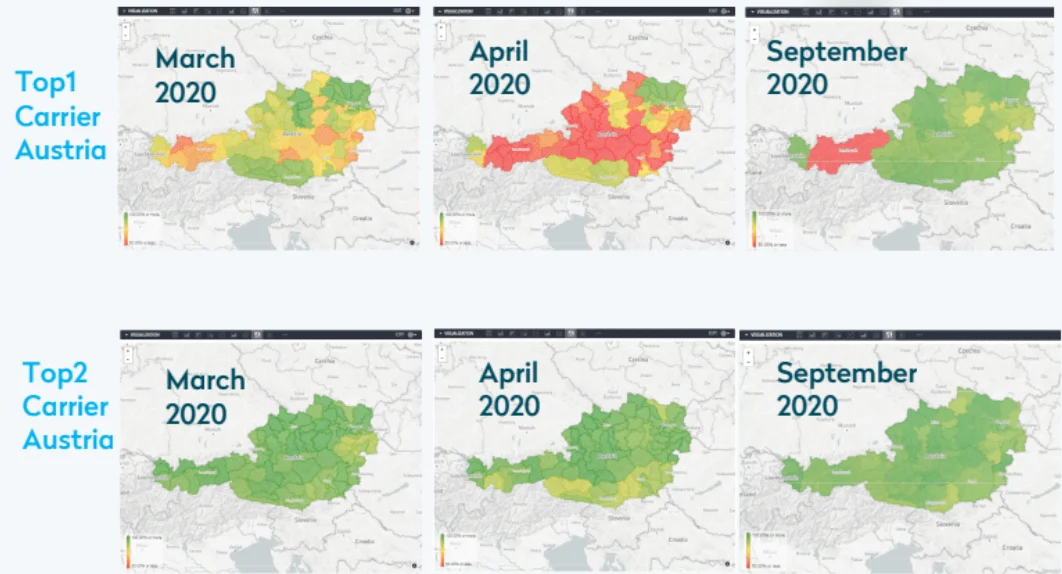
An analysis of Seven Senders on the E+1 delivery – the delivery one day after the parcel was fed into the network – of two major carriers in Austria in the months of March, April, and September, for example, revealed major differences:
Carrier 2, unlike Carrier 1, remained consistently in the literally green zone during the observed period, while Carrier 1 experienced delays.
In France, another challenge emerged: Due to COVID-19, the hubs of the French supply network Mondial Relay were closed on 17 March. As a result, the supply chain of this supplier completely collapsed.
Retailers who had their parcels delivered exclusively via this service provider were no longer able to deliver their goods to the end customer. Other carriers in Europe restricted their services in order to maintain the basic service.
For example, they reduced the permitted weight of individual parcels or the number of them, only allowed online shops a few days to feed in their parcels, or massively increased prices. In view of the contact restrictions, some carriers, for example in France, Italy, and Austria, discontinued the option of payment on delivery.

„The more restrictive the lockdown was imposed, especially on stationary retail trade, the greater the parcel volume, i.e., the number of parcels fed into the delivery networks“ Thomas Hagemann, Co-CEO of Seven Senders
“If capacities are limited, what will be left for medium-sized and smaller retailers?” asks the logistics expert. The only way to counter reduced capacities and services is to create an independent and flexible carrier mix.
Growing package volume – growing challenges
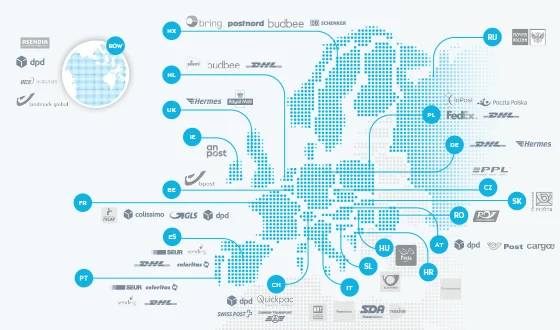
The pandemic situation comes on top of the challenges already faced by shipments within Europe before the COVID-19 pandemic. With more than 20 languages, over 100 relevant carriers in Europe, and many different delivery needs. Europe is very diverse and therefore difficult for retailers to manage.
In addition, the volume of parcels to be handled in Europe has been growing continuously for years. Even without Corona, 2020 would have been another record year for online commerce,” says the Co-CEO of Seven Senders.
The Bundesverband Paket und Expresslogistik e. V. (German Parcel and Express Logistics Association) also expects massive growth for this year’s Christmas business (November to December).
It expects an increase in deliveries to private households by about 60 million parcels in Germany compared to the previous year to around 420 million parcel shipments. This represents an increase of a good 16 percent. Worldwide, the parcel volume is expected to increase by an average of up to 14.8% by 2024.
Be prepared? But how?
What options do retailers have in view of the formula “COVID-19 x growth x Q4 2020”? “We recommend being prepared,” explains Thomas Hagemann. In any case, an analysis of one’s own carriers and their structure would be helpful to identify any bottlenecks in the supply chain.
“Independence is probably the biggest lever retailers have,” says Thomas Hagemann, and advises “cutting the supply chain off at the back” – in other words, relying on a carrier mix for the last mile.
Traders should therefore deliver their parcels to the destination country via freight forwarders, and then have the flexibility to decide for one month, depending on the restrictions in the country or the individual carriers, who to hand over the parcel to for the last mile. This strategy has proved to be massively successful for some customers of Seven Senders during the 1st wave of the pandemic, as the Co-CEO emphasizes.
Seven Senders was able to help by rerouting its customers’ parcels to other carriers that were working at the time in the event of delivery problems. Because: “I don’t think any of us can afford lost sales,” concludes Thomas Hagemann.
This is why Seven Senders offers its customers a connection to its network of more than 100 carriers worldwide. In this way, Seven Senders can guarantee online merchants the necessary flexibility and independence in international parcel shipping, even though each customer can deal with his or her concerns through a single contact person.
Conclusion
With flexibility, independence, and the support of Seven Senders, online retailers are well prepared for the challenge of the peak season under pandemic conditions: COVID-19 x growth x Q4 2020! Europe’s leading delivery platform will be happy to advise you on how the perfect carrier mix for an independent and flexible delivery network can be designed to ensure the safe and punctual delivery of international parcels.