Thomas Hagemann, Founder and Co-CEO of Seven Senders, discusses the various opportunities and challenges of successful cross-border delivery and how online retailers can use shipping performance to propel international growth.
Mr. Hagemann, how fast does an order need to be delivered to the customer?
There's no one answer to that. If someone orders a cheap mobile phone case, it is probably not so important whether the product is delivered on the same day or in two or three days.
But if a customer orders an evening dress that she needs for a certain occasion, the delivery time is decisive. This is because the product has no value if it comes too late and she will probably send it back to the retailer.

This correlation illustrates why studies show that same-day delivery is not the customer's biggest wish, although this is often proclaimed. Keeping your delivery promise, however, is essential to high customer satisfaction.
"For e-commerce customers, the choice of delivery options, the promise of delivery, and the fulfillment of that promise are immensely important."
Thomas Hagemann, Co-Founder SEVEN SENDERS
So customers want a variety of delivery options – which ones do they prefer?
Let's start with same-day delivery. This service is usually reserved for customers in metropolitan areas, excluding orders at Amazon, even though the market leader has not yet found a solution to offer this service nationwide. The reason for this is that the ordered product must always cover the distance between the warehouse location and the customer's address. And that takes time.
Same-day delivery only makes sense for customers if the latest order option is not too early in the day. For these reasons, we currently see other delivery options more in the focus of consumers and retailers.
Services such as Wish-Day Delivery or Time-Window Delivery are more common than same-day and are also a general driver of the last mile industry. Videos about parcels being left in gardens or tossed onto balconies have spread virally on the internet – here it is certainly difficult for any retailer to be lenient with the carriers.
However, the logistician is often faced with the challenge of delivering a parcel to a recipient who is not at home. A delivery to the front door is a risk for all parties during normal working hours, especially if the recipient does not explicitly request it.
The Time Window option, on the other hand, increases the probability of successful delivery and thus customer satisfaction immensely. Pickup points or parcel lockers are also very popular. In Germany, however, there is a lack of a uniform, cross-carrier solution. Not least because of this, a large proportion of customers will probably prefer to receive the parcel personally in the future.
Delivery times in e-commerce: the traditional distinctions
- Standard delivery: delivery within the normal delivery times by delivery services, usually 2-3 days for domestic shipments
- Express delivery: Secure next-day delivery
- Same-day delivery: Delivery on the day of the order
- Wish-day delivery: Delivery on the desired day (fast or intended late)
- Time-window delivery: Delivery on a day in a specific time period
What are the biggest challenges in meeting and predicting delivery times?
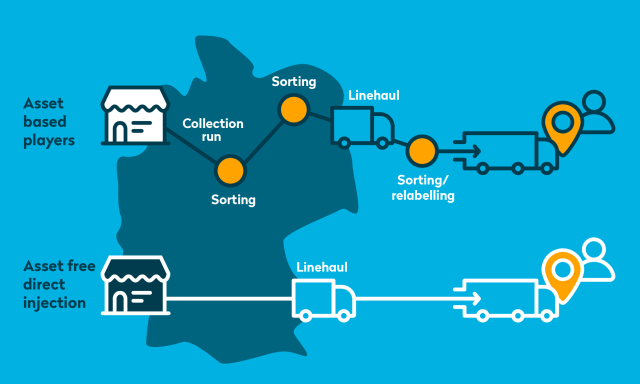
Basically, when analyzing delivery times and predictability, a distinction must be made between domestic deliveries and cross-border deliveries. In the case of standard parcel shipments within a country, the collecting party is usually also the delivering party and the parcel, therefore, does not leave the network of the delivery service: in theory, transit and arrival times can be predicted relatively well.
This presupposes that the carrier knows exactly the throughput times of each possible source-desk relationship. Another logistical option is direct injection. Here the parcels are taken from the retailer's warehouse and fed into the distribution hub and picked up directly by the local carrier.
The advantage for the predictability of the parcel arrival time is obvious: Fewer line hauls lead to a faster supply chain. The accuracy of predictability is more or less reduced to the reliability of the local carrier.
Seven Senders can also help customers to be more accurate in predicting parcel arrival times. In this way, relatively small time windows in relation to the distance between the warehouse and the consumer can be maintained with a high degree of probability.
How do merchants have to set up their shipping to be successful in cross-border trading?
As optimized cross-border shipping quickly becomes complex for merchants. They have to position themselves logistically in the best possible way and prepare solutions for international shipments just as meticulously as those for domestic shipments. Otherwise, they will not be successful abroad.
On the positive side, logistics is an opportunity for retailers to differentiate themselves. The choice of the right local carrier is only a compulsory task. The integration of further services in the sense of a multi-carrier strategy is increasingly becoming a competitive advantage, especially when trying to enter new markets.
For successful scaling, high conversion, and high retention, retailers must act like the local market leaders. In addition, retailers should not only optimize the physical supply chain but at least equally take the flow of information to the customer into their own hands and proactively communicate with their customers.
This field should not be left to the carriers. Rather, every retailer can use the carriers' status updates to send out email messages for specific occasions. Retailers such as EMP show that transparency increases satisfaction in the delivery process and even negative delivery performance is more likely to be forgiven.
"In order to remain competitive, e-commerce merchants must act like domestic market leaders in cross-border delivery." Thomas Hagemann, Founder and Co-CEO Seven Senders
How can Seven Senders help retailers to achieve excellent shipping performance?
Our one-stop solution delivery platform offers shippers an extensive international carrier network and additional shipping services like tracking, notifications, labels, and return management. Customers particularly benefit from the Europe-wide direct injection solution for cross-border shipments. We ensure that retailers can act as local players abroad, fulfill their shipping promises, and thus build long-term customer loyalty.